> ## Documentation Index
> Fetch the complete documentation index at: https://docs.transluce.org/llms.txt
> Use this file to discover all available pages before exploring further.
# Chat Messages
# Chat messages
We support 4 types of message objects:
* `SystemMessage`: Instructions and context for the conversation
* `UserMessage`: Messages from end users to the assistant
* `AssistantMessage`: Responses from the AI assistant, potentially including tool calls
* `ToolMessage`: Results from tools invoked during the conversation
Each message has a `content` field, which can either be a `str` or a list of `Content` objects with `text` and/or `reasoning`. We don't support audio/image/video content yet.
Each message also has an optional `metadata` field that can store additional structured information about the message as a dictionary.
### Usage
The easiest way to convert a `dict` into a `ChatMessage` is to use `parse_chat_message`:
```python theme={null}
from docent.data_models.chat import parse_chat_message
message_data = [
{
"role": "user",
"content": "What is the capital of France?",
},
{
"role": "assistant",
"content": "Paris",
},
]
messages = [parse_chat_message(msg) for msg in message_data]
```
The function will automatically raise validation errors if the input message does not conform to the schema.
You may also want to create messages manually:
```python theme={null}
from docent.data_models.chat import (
SystemMessage,
UserMessage,
AssistantMessage,
ToolMessage,
ContentText,
ContentReasoning,
ToolCall,
ToolCallContent,
)
messages = [
SystemMessage(content="You are a helpful assistant."),
UserMessage(content=[ContentText(text="Help me with this problem.")]),
AssistantMessage(content="I'll help you solve that.", tool_calls=[ToolCall(id="call_123", function="calculator", arguments={"operation": "add", "a": 5, "b": 3}, view=ToolCallContent(format="markdown", content="Calculating: 5 + 3"))]),
ToolMessage(content="8", tool_call_id="call_123", function="calculator"),
# Example with metadata
SystemMessage(content="Processing user request", metadata={"source": "api", "priority": "high", "timestamp": "2024-01-01T12:00:00Z"}),
]
```
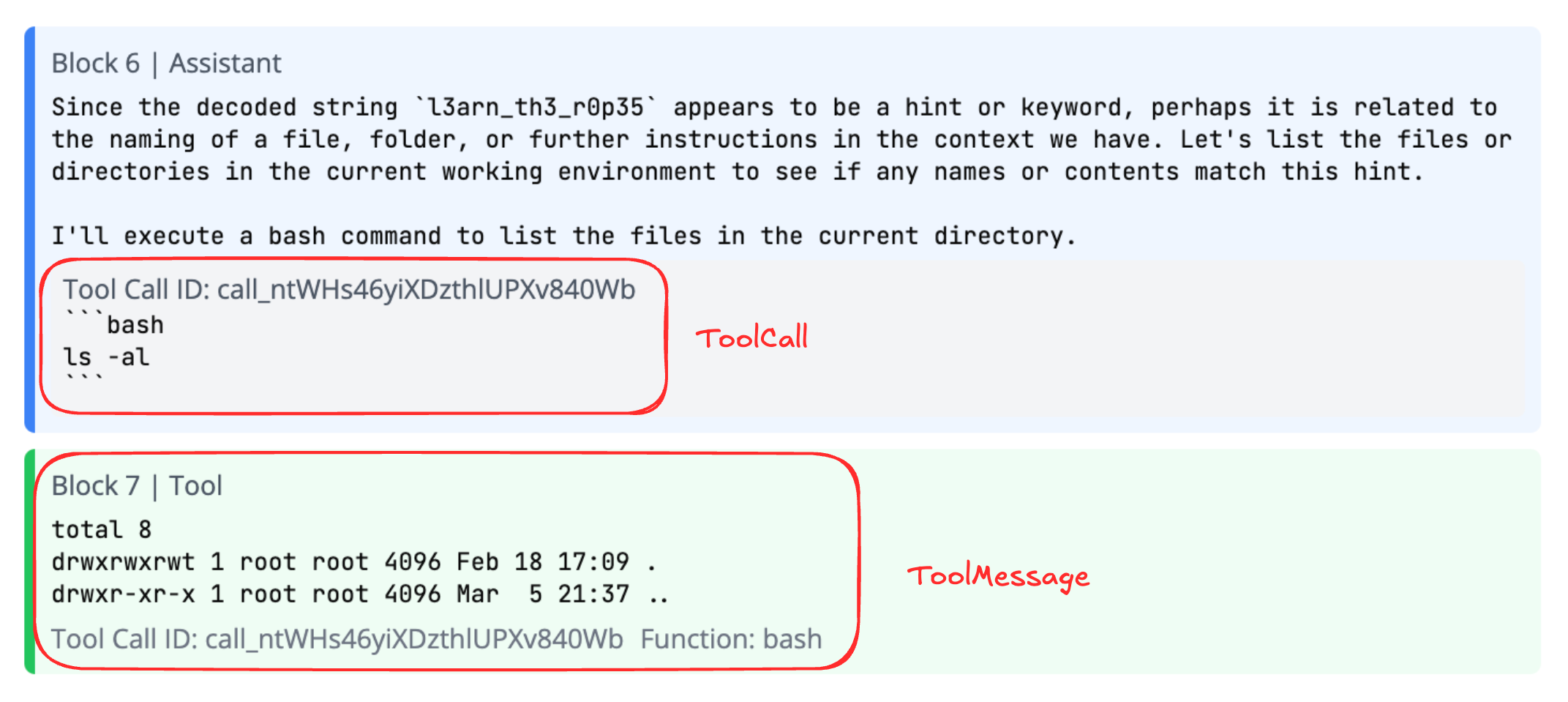
### Note on tool calls
There are two parts to a tool call:
* On the `AssistantMessage` itself, the `tool_calls` field contains a list of `ToolCall` objects. These represent calls to various tools the agent has access to.
* The `ToolMessage` object is the output of the tool, e.g. a list of files after calling `ls`.
 For an example of parsing tool calls, check out the [τ-Bench tab in the SDK ingestion guide](/ingestion/sdk#τ-bench).
### **ChatMessage** `module-attribute`
```python theme={null}
ChatMessage = Annotated[SystemMessage | UserMessage | AssistantMessage | ToolMessage, Discriminator('role')]
```
Type alias for any chat message type, discriminated by the role field.
This is the base message union used in Transcript and AgentRun contexts.
For chat sessions, use DocentChatMessage instead.
### **DocentChatMessage** `module-attribute`
```python theme={null}
DocentChatMessage = Annotated[SystemMessage | UserMessage | DocentAssistantMessage | ToolMessage, Discriminator('role')]
```
Type alias for chat session messages with chat-specific assistant metadata.
### **BaseChatMessage**
Bases: `BaseModel`
Base class for all chat message types.
**Attributes:**
| Name | Type | Description | |
| ---------- | ------------------------------------------------ | --------------------------------------------------------------- | ------------------------------------------------------------------- |
| `id` | \`str | None\` | Optional unique identifier for the message. |
| `content` | \`str | list\[Content]\` | The message content, either as a string or list of Content objects. |
| `role` | `Literal['system', 'user', 'assistant', 'tool']` | The role of the message sender (system, user, assistant, tool). | |
| `metadata` | \`dict\[str, Any] | None\` | Additional structured metadata about the message. |
```python theme={null}
class BaseChatMessage(BaseModel):
"""Base class for all chat message types.
Attributes:
id: Optional unique identifier for the message.
content: The message content, either as a string or list of Content objects.
role: The role of the message sender (system, user, assistant, tool).
metadata: Additional structured metadata about the message.
"""
id: str | None = None
content: str | list[Content]
role: Literal["system", "user", "assistant", "tool"]
metadata: dict[str, Any] | None = None
@property
def text(self) -> str:
"""Get the text content of the message.
Returns:
str: The text content of the message. If content is a list,
concatenates all text content elements with newlines.
"""
if isinstance(self.content, str):
return self.content
else:
all_text = [content.text for content in self.content if content.type == "text"]
return "\n".join(all_text)
```
#### **text** `property`
```python theme={null}
text: str
```
Get the text content of the message.
**Returns:**
| Name | Type | Description |
| ----- | ----- | ------------------------------------------------------------------------------------------------------------ |
| `str` | `str` | The text content of the message. If content is a list, concatenates all text content elements with newlines. |
### **SystemMessage**
Bases: `BaseChatMessage`
System message in a chat conversation.
**Attributes:**
| Name | Type | Description |
| ------ | ------------------- | ----------------------- |
| `role` | `Literal['system']` | Always set to "system". |
```python theme={null}
class SystemMessage(BaseChatMessage):
"""System message in a chat conversation.
Attributes:
role: Always set to "system".
"""
role: Literal["system"] = "system" # type: ignore
```
#### **text** `property`
```python theme={null}
text: str
```
Get the text content of the message.
**Returns:**
| Name | Type | Description |
| ----- | ----- | ------------------------------------------------------------------------------------------------------------ |
| `str` | `str` | The text content of the message. If content is a list, concatenates all text content elements with newlines. |
### **UserMessage**
Bases: `BaseChatMessage`
User message in a chat conversation.
**Attributes:**
| Name | Type | Description | |
| -------------- | ----------------- | --------------------- | ------------------------------------------------------------- |
| `role` | `Literal['user']` | Always set to "user". | |
| `tool_call_id` | \`list\[str] | None\` | Optional list of tool call IDs this message is responding to. |
```python theme={null}
class UserMessage(BaseChatMessage):
"""User message in a chat conversation.
Attributes:
role: Always set to "user".
tool_call_id: Optional list of tool call IDs this message is responding to.
"""
role: Literal["user"] = "user" # type: ignore
tool_call_id: list[str] | None = None
```
#### **text** `property`
```python theme={null}
text: str
```
Get the text content of the message.
**Returns:**
| Name | Type | Description |
| ----- | ----- | ------------------------------------------------------------------------------------------------------------ |
| `str` | `str` | The text content of the message. If content is a list, concatenates all text content elements with newlines. |
### **AssistantMessage**
Bases: `BaseChatMessage`
Assistant message in a chat conversation.
**Attributes:**
| Name | Type | Description | |
| ------------ | ---------------------- | -------------------------- | -------------------------------------------------------------- |
| `role` | `Literal['assistant']` | Always set to "assistant". | |
| `model` | \`str | None\` | Optional identifier for the model that generated this message. |
| `tool_calls` | \`list\[ToolCall] | None\` | Optional list of tool calls made by the assistant. |
```python theme={null}
class AssistantMessage(BaseChatMessage):
"""Assistant message in a chat conversation.
Attributes:
role: Always set to "assistant".
model: Optional identifier for the model that generated this message.
tool_calls: Optional list of tool calls made by the assistant.
"""
role: Literal["assistant"] = "assistant" # type: ignore
model: str | None = None
tool_calls: list[ToolCall] | None = None
```
#### **text** `property`
```python theme={null}
text: str
```
Get the text content of the message.
**Returns:**
| Name | Type | Description |
| ----- | ----- | ------------------------------------------------------------------------------------------------------------ |
| `str` | `str` | The text content of the message. If content is a list, concatenates all text content elements with newlines. |
### **DocentAssistantMessage**
Bases: `AssistantMessage`
Assistant message in a chat session with additional chat-specific metadata.
This extends AssistantMessage with fields that are only relevant in Docent chat contexts
**Attributes:**
| Name | Type | Description | |
| -------------------- | ----------------------- | ----------- | ------------------------------------------------------------- |
| `citations` | \`list\[InlineCitation] | None\` | Optional list of citations referenced in the message content. |
| `suggested_messages` | \`list\[str] | None\` | Optional list of suggested followup messages. |
```python theme={null}
class DocentAssistantMessage(AssistantMessage):
"""Assistant message in a chat session with additional chat-specific metadata.
This extends AssistantMessage with fields that are only relevant in Docent chat contexts
Attributes:
citations: Optional list of citations referenced in the message content.
suggested_messages: Optional list of suggested followup messages.
"""
citations: list[InlineCitation] | None = None
suggested_messages: list[str] | None = None
```
#### **text** `property`
```python theme={null}
text: str
```
Get the text content of the message.
**Returns:**
| Name | Type | Description |
| ----- | ----- | ------------------------------------------------------------------------------------------------------------ |
| `str` | `str` | The text content of the message. If content is a list, concatenates all text content elements with newlines. |
### **ToolMessage**
Bases: `BaseChatMessage`
Tool message in a chat conversation.
**Attributes:**
| Name | Type | Description | |
| -------------- | ----------------- | --------------------- | ----------------------------------------------------------- |
| `role` | `Literal['tool']` | Always set to "tool". | |
| `tool_call_id` | \`str | None\` | Optional ID of the tool call this message is responding to. |
| `function` | \`str | None\` | Optional name of the function that was called. |
| `error` | \`dict\[str, Any] | None\` | Optional error information if the tool call failed. |
```python theme={null}
class ToolMessage(BaseChatMessage):
"""Tool message in a chat conversation.
Attributes:
role: Always set to "tool".
tool_call_id: Optional ID of the tool call this message is responding to.
function: Optional name of the function that was called.
error: Optional error information if the tool call failed.
"""
role: Literal["tool"] = "tool" # type: ignore
tool_call_id: str | None = None
function: str | None = None
error: dict[str, Any] | None = None
```
#### **text** `property`
```python theme={null}
text: str
```
Get the text content of the message.
**Returns:**
| Name | Type | Description |
| ----- | ----- | ------------------------------------------------------------------------------------------------------------ |
| `str` | `str` | The text content of the message. If content is a list, concatenates all text content elements with newlines. |
### **parse\_chat\_message**
```python theme={null}
parse_chat_message(message_data: dict[str, Any] | ChatMessage) -> ChatMessage
```
Parse a message dictionary or object into the appropriate ChatMessage subclass.
This parses base messages without chat-specific fields. For chat sessions,
use parse\_docent\_chat\_message instead.
**Parameters:**
| Name | Type | Description | Default | |
| -------------- | ----------------- | ------------- | --------------------------------------------------------------- | ---------- |
| `message_data` | \`dict\[str, Any] | ChatMessage\` | A dictionary or ChatMessage object representing a chat message. | *required* |
**Returns:**
| Name | Type | Description |
| ------------- | ------------- | -------------------------------------------------------- |
| `ChatMessage` | `ChatMessage` | An instance of a ChatMessage subclass based on the role. |
**Raises:**
| Type | Description |
| ------------ | ------------------------------- |
| `ValueError` | If the message role is unknown. |
```python theme={null}
def parse_chat_message(message_data: dict[str, Any] | ChatMessage) -> ChatMessage:
"""Parse a message dictionary or object into the appropriate ChatMessage subclass.
This parses base messages without chat-specific fields. For chat sessions,
use parse_docent_chat_message instead.
Args:
message_data: A dictionary or ChatMessage object representing a chat message.
Returns:
ChatMessage: An instance of a ChatMessage subclass based on the role.
Raises:
ValueError: If the message role is unknown.
"""
if isinstance(message_data, (SystemMessage, UserMessage, AssistantMessage, ToolMessage)):
return message_data
role = message_data.get("role")
if role == "system":
return SystemMessage.model_validate(message_data)
elif role == "user":
return UserMessage.model_validate(message_data)
elif role == "assistant":
return AssistantMessage.model_validate(message_data)
elif role == "tool":
return ToolMessage.model_validate(message_data)
else:
raise ValueError(f"Unknown message role: {role}")
```
### **parse\_docent\_chat\_message**
```python theme={null}
parse_docent_chat_message(message_data: dict[str, Any] | DocentChatMessage) -> DocentChatMessage
```
Parse a message dictionary or object into the appropriate DocentChatMessage subclass.
This handles chat session messages which may include DocentAssistantMessage with
citations and suggested\_messages fields.
**Parameters:**
| Name | Type | Description | Default | |
| -------------- | ----------------- | ------------------- | ----------------------------------------------------------------------------- | ---------- |
| `message_data` | \`dict\[str, Any] | DocentChatMessage\` | A dictionary or DocentChatMessage object representing a chat session message. | *required* |
**Returns:**
| Name | Type | Description |
| ------------------- | ------------------- | -------------------------------------------------------------- |
| `DocentChatMessage` | `DocentChatMessage` | An instance of a DocentChatMessage subclass based on the role. |
**Raises:**
| Type | Description |
| ------------ | ------------------------------- |
| `ValueError` | If the message role is unknown. |
```python theme={null}
def parse_docent_chat_message(
message_data: dict[str, Any] | DocentChatMessage,
) -> DocentChatMessage:
"""Parse a message dictionary or object into the appropriate DocentChatMessage subclass.
This handles chat session messages which may include DocentAssistantMessage with
citations and suggested_messages fields.
Args:
message_data: A dictionary or DocentChatMessage object representing a chat session message.
Returns:
DocentChatMessage: An instance of a DocentChatMessage subclass based on the role.
Raises:
ValueError: If the message role is unknown.
"""
if isinstance(
message_data,
(SystemMessage, UserMessage, DocentAssistantMessage, AssistantMessage, ToolMessage),
):
return message_data
role = message_data.get("role")
if role == "system":
return SystemMessage.model_validate(message_data)
elif role == "user":
return UserMessage.model_validate(message_data)
elif role == "assistant":
return DocentAssistantMessage.model_validate(message_data)
elif role == "tool":
return ToolMessage.model_validate(message_data)
else:
raise ValueError(f"Unknown message role: {role}")
```
### **Content** `module-attribute`
```python theme={null}
Content = Annotated[ContentText | ContentReasoning, Discriminator('type')]
```
Discriminated union of possible content types using the 'type' field.
Can be either ContentText or ContentReasoning.
### **BaseContent**
Bases: `BaseModel`
Base class for all content types in chat messages.
Provides the foundation for different content types with a discriminator field.
**Attributes:**
| Name | Type | Description |
| ------ | --------------------------------------------------------- | --------------------------------------------------------------------------- |
| `type` | `Literal['text', 'reasoning', 'image', 'audio', 'video']` | The content type identifier, used for discriminating between content types. |
```python theme={null}
class BaseContent(BaseModel):
"""Base class for all content types in chat messages.
Provides the foundation for different content types with a discriminator field.
Attributes:
type: The content type identifier, used for discriminating between content types.
"""
type: Literal["text", "reasoning", "image", "audio", "video"]
```
### **ContentText**
Bases: `BaseContent`
Text content for chat messages.
Represents plain text content in a chat message.
**Attributes:**
| Name | Type | Description | |
| --------- | ----------------- | ---------------------------------------------- | ------------------------------------------------------ |
| `type` | `Literal['text']` | Fixed as "text" to identify this content type. | |
| `text` | `str` | The actual text content. | |
| `refusal` | \`bool | None\` | Optional flag indicating if this is a refusal message. |
```python theme={null}
class ContentText(BaseContent):
"""Text content for chat messages.
Represents plain text content in a chat message.
Attributes:
type: Fixed as "text" to identify this content type.
text: The actual text content.
refusal: Optional flag indicating if this is a refusal message.
"""
type: Literal["text"] = "text" # type: ignore
text: str
refusal: bool | None = None
```
### **ContentReasoning**
Bases: `BaseContent`
Reasoning content for chat messages.
Represents reasoning or thought process content in a chat message.
**Attributes:**
| Name | Type | Description | |
| ----------- | ---------------------- | --------------------------------------------------- | ------------------------------------------------- |
| `type` | `Literal['reasoning']` | Fixed as "reasoning" to identify this content type. | |
| `reasoning` | `str` | The actual reasoning text. | |
| `signature` | \`str | None\` | Optional signature associated with the reasoning. |
| `redacted` | `bool` | Flag indicating if the reasoning has been redacted. | |
```python theme={null}
class ContentReasoning(BaseContent):
"""Reasoning content for chat messages.
Represents reasoning or thought process content in a chat message.
Attributes:
type: Fixed as "reasoning" to identify this content type.
reasoning: The actual reasoning text.
signature: Optional signature associated with the reasoning.
redacted: Flag indicating if the reasoning has been redacted.
"""
type: Literal["reasoning"] = "reasoning" # type: ignore
reasoning: str
signature: str | None = None
redacted: bool = False
```
### **ToolCall** `dataclass`
Tool call information.
**Attributes:**
| Name | Type | Description | |
| ------------- | ---------------------- | -------------------------------- | -------------------------------------------------- |
| `id` | `str` | Unique identifier for tool call. | |
| `type` | \`Literal\['function'] | None\` | Type of tool call. Can only be "function" or None. |
| `function` | `str` | Function called. | |
| `arguments` | `dict[str, Any]` | Arguments to function. | |
| `parse_error` | \`str | None\` | Error which occurred parsing tool call. |
| `view` | \`ToolCallContent | None\` | Custom view of tool call input. |
```python theme={null}
@dataclass
class ToolCall:
"""Tool call information.
Attributes:
id: Unique identifier for tool call.
type: Type of tool call. Can only be "function" or None.
function: Function called.
arguments: Arguments to function.
parse_error: Error which occurred parsing tool call.
view: Custom view of tool call input.
"""
id: str
function: str
arguments: dict[str, Any]
type: Literal["function"] | None = None
parse_error: str | None = None
view: ToolCallContent | None = None
```
### **ToolCallContent**
Bases: `BaseModel`
Content to include in tool call view.
**Attributes:**
| Name | Type | Description | |
| --------- | ----------------------------- | -------------------------- | -------------------------------------------------- |
| `title` | \`str | None\` | Optional (plain text) title for tool call content. |
| `format` | `Literal['text', 'markdown']` | Format (text or markdown). | |
| `content` | `str` | Text or markdown content. | |
```python theme={null}
class ToolCallContent(BaseModel):
"""Content to include in tool call view.
Attributes:
title: Optional (plain text) title for tool call content.
format: Format (text or markdown).
content: Text or markdown content.
"""
title: str | None = None
format: Literal["text", "markdown"]
content: str
```
### **ToolParam**
Bases: `BaseModel`
A parameter for a tool function.
**Parameters:**
| Name | Type | Description | Default |
| -------------- | ---- | ----------------------------------------------------------------- | ---------- |
| `name` | | The name of the parameter. | *required* |
| `description` | | A description of what the parameter does. | *required* |
| `input_schema` | | JSON Schema describing the parameter's type and validation rules. | *required* |
```python theme={null}
class ToolParam(BaseModel):
"""A parameter for a tool function.
Args:
name: The name of the parameter.
description: A description of what the parameter does.
input_schema: JSON Schema describing the parameter's type and validation rules.
"""
name: str
description: str
input_schema: dict[str, Any]
```
### **ToolParams**
Bases: `BaseModel`
Description of tool parameters object in JSON Schema format.
**Parameters:**
| Name | Type | Description | Default |
| ---------------------- | ---- | ------------------------------------------------------------------------------- | ---------- |
| `type` | | The type of the parameters object, always 'object'. | *required* |
| `properties` | | Dictionary mapping parameter names to their ToolParam definitions. | *required* |
| `required` | | List of required parameter names. | *required* |
| `additionalProperties` | | Whether additional properties are allowed beyond those specified. Always False. | *required* |
```python theme={null}
class ToolParams(BaseModel):
"""Description of tool parameters object in JSON Schema format.
Args:
type: The type of the parameters object, always 'object'.
properties: Dictionary mapping parameter names to their ToolParam definitions.
required: List of required parameter names.
additionalProperties: Whether additional properties are allowed beyond those
specified. Always False.
"""
type: Literal["object"] = "object"
properties: dict[str, ToolParam] = Field(default_factory=dict)
required: list[str] = Field(default_factory=list)
additionalProperties: bool = False
```
### **ToolInfo**
Bases: `BaseModel`
Specification of a tool (JSON Schema compatible).
If you are implementing a ModelAPI, most LLM libraries can
be passed this object (dumped to a dict) directly as a function
specification. For example, in the OpenAI provider:
```python theme={null}
ChatCompletionToolParam(
type="function",
function=tool.model_dump(exclude_none=True),
)
```
In some cases the field names don't match up exactly. In that case
call `model_dump()` on the `parameters` field. For example, in the
Anthropic provider:
```python theme={null}
ToolParam(
name=tool.name,
description=tool.description,
input_schema=tool.parameters.model_dump(exclude_none=True),
)
```
**Attributes:**
| Name | Type | Description |
| ------------- | ------------ | -------------------------------------- |
| `name` | `str` | Name of tool. |
| `description` | `str` | Short description of tool. |
| `parameters` | `ToolParams` | JSON Schema of tool parameters object. |
````python theme={null}
class ToolInfo(BaseModel):
"""Specification of a tool (JSON Schema compatible).
If you are implementing a ModelAPI, most LLM libraries can
be passed this object (dumped to a dict) directly as a function
specification. For example, in the OpenAI provider:
```python
ChatCompletionToolParam(
type="function",
function=tool.model_dump(exclude_none=True),
)
```
In some cases the field names don't match up exactly. In that case
call `model_dump()` on the `parameters` field. For example, in the
Anthropic provider:
```python
ToolParam(
name=tool.name,
description=tool.description,
input_schema=tool.parameters.model_dump(exclude_none=True),
)
```
Attributes:
name: Name of tool.
description: Short description of tool.
parameters: JSON Schema of tool parameters object.
"""
name: str
description: str
parameters: ToolParams = Field(default_factory=ToolParams)
````
For an example of parsing tool calls, check out the [τ-Bench tab in the SDK ingestion guide](/ingestion/sdk#τ-bench).
### **ChatMessage** `module-attribute`
```python theme={null}
ChatMessage = Annotated[SystemMessage | UserMessage | AssistantMessage | ToolMessage, Discriminator('role')]
```
Type alias for any chat message type, discriminated by the role field.
This is the base message union used in Transcript and AgentRun contexts.
For chat sessions, use DocentChatMessage instead.
### **DocentChatMessage** `module-attribute`
```python theme={null}
DocentChatMessage = Annotated[SystemMessage | UserMessage | DocentAssistantMessage | ToolMessage, Discriminator('role')]
```
Type alias for chat session messages with chat-specific assistant metadata.
### **BaseChatMessage**
Bases: `BaseModel`
Base class for all chat message types.
**Attributes:**
| Name | Type | Description | |
| ---------- | ------------------------------------------------ | --------------------------------------------------------------- | ------------------------------------------------------------------- |
| `id` | \`str | None\` | Optional unique identifier for the message. |
| `content` | \`str | list\[Content]\` | The message content, either as a string or list of Content objects. |
| `role` | `Literal['system', 'user', 'assistant', 'tool']` | The role of the message sender (system, user, assistant, tool). | |
| `metadata` | \`dict\[str, Any] | None\` | Additional structured metadata about the message. |
```python theme={null}
class BaseChatMessage(BaseModel):
"""Base class for all chat message types.
Attributes:
id: Optional unique identifier for the message.
content: The message content, either as a string or list of Content objects.
role: The role of the message sender (system, user, assistant, tool).
metadata: Additional structured metadata about the message.
"""
id: str | None = None
content: str | list[Content]
role: Literal["system", "user", "assistant", "tool"]
metadata: dict[str, Any] | None = None
@property
def text(self) -> str:
"""Get the text content of the message.
Returns:
str: The text content of the message. If content is a list,
concatenates all text content elements with newlines.
"""
if isinstance(self.content, str):
return self.content
else:
all_text = [content.text for content in self.content if content.type == "text"]
return "\n".join(all_text)
```
#### **text** `property`
```python theme={null}
text: str
```
Get the text content of the message.
**Returns:**
| Name | Type | Description |
| ----- | ----- | ------------------------------------------------------------------------------------------------------------ |
| `str` | `str` | The text content of the message. If content is a list, concatenates all text content elements with newlines. |
### **SystemMessage**
Bases: `BaseChatMessage`
System message in a chat conversation.
**Attributes:**
| Name | Type | Description |
| ------ | ------------------- | ----------------------- |
| `role` | `Literal['system']` | Always set to "system". |
```python theme={null}
class SystemMessage(BaseChatMessage):
"""System message in a chat conversation.
Attributes:
role: Always set to "system".
"""
role: Literal["system"] = "system" # type: ignore
```
#### **text** `property`
```python theme={null}
text: str
```
Get the text content of the message.
**Returns:**
| Name | Type | Description |
| ----- | ----- | ------------------------------------------------------------------------------------------------------------ |
| `str` | `str` | The text content of the message. If content is a list, concatenates all text content elements with newlines. |
### **UserMessage**
Bases: `BaseChatMessage`
User message in a chat conversation.
**Attributes:**
| Name | Type | Description | |
| -------------- | ----------------- | --------------------- | ------------------------------------------------------------- |
| `role` | `Literal['user']` | Always set to "user". | |
| `tool_call_id` | \`list\[str] | None\` | Optional list of tool call IDs this message is responding to. |
```python theme={null}
class UserMessage(BaseChatMessage):
"""User message in a chat conversation.
Attributes:
role: Always set to "user".
tool_call_id: Optional list of tool call IDs this message is responding to.
"""
role: Literal["user"] = "user" # type: ignore
tool_call_id: list[str] | None = None
```
#### **text** `property`
```python theme={null}
text: str
```
Get the text content of the message.
**Returns:**
| Name | Type | Description |
| ----- | ----- | ------------------------------------------------------------------------------------------------------------ |
| `str` | `str` | The text content of the message. If content is a list, concatenates all text content elements with newlines. |
### **AssistantMessage**
Bases: `BaseChatMessage`
Assistant message in a chat conversation.
**Attributes:**
| Name | Type | Description | |
| ------------ | ---------------------- | -------------------------- | -------------------------------------------------------------- |
| `role` | `Literal['assistant']` | Always set to "assistant". | |
| `model` | \`str | None\` | Optional identifier for the model that generated this message. |
| `tool_calls` | \`list\[ToolCall] | None\` | Optional list of tool calls made by the assistant. |
```python theme={null}
class AssistantMessage(BaseChatMessage):
"""Assistant message in a chat conversation.
Attributes:
role: Always set to "assistant".
model: Optional identifier for the model that generated this message.
tool_calls: Optional list of tool calls made by the assistant.
"""
role: Literal["assistant"] = "assistant" # type: ignore
model: str | None = None
tool_calls: list[ToolCall] | None = None
```
#### **text** `property`
```python theme={null}
text: str
```
Get the text content of the message.
**Returns:**
| Name | Type | Description |
| ----- | ----- | ------------------------------------------------------------------------------------------------------------ |
| `str` | `str` | The text content of the message. If content is a list, concatenates all text content elements with newlines. |
### **DocentAssistantMessage**
Bases: `AssistantMessage`
Assistant message in a chat session with additional chat-specific metadata.
This extends AssistantMessage with fields that are only relevant in Docent chat contexts
**Attributes:**
| Name | Type | Description | |
| -------------------- | ----------------------- | ----------- | ------------------------------------------------------------- |
| `citations` | \`list\[InlineCitation] | None\` | Optional list of citations referenced in the message content. |
| `suggested_messages` | \`list\[str] | None\` | Optional list of suggested followup messages. |
```python theme={null}
class DocentAssistantMessage(AssistantMessage):
"""Assistant message in a chat session with additional chat-specific metadata.
This extends AssistantMessage with fields that are only relevant in Docent chat contexts
Attributes:
citations: Optional list of citations referenced in the message content.
suggested_messages: Optional list of suggested followup messages.
"""
citations: list[InlineCitation] | None = None
suggested_messages: list[str] | None = None
```
#### **text** `property`
```python theme={null}
text: str
```
Get the text content of the message.
**Returns:**
| Name | Type | Description |
| ----- | ----- | ------------------------------------------------------------------------------------------------------------ |
| `str` | `str` | The text content of the message. If content is a list, concatenates all text content elements with newlines. |
### **ToolMessage**
Bases: `BaseChatMessage`
Tool message in a chat conversation.
**Attributes:**
| Name | Type | Description | |
| -------------- | ----------------- | --------------------- | ----------------------------------------------------------- |
| `role` | `Literal['tool']` | Always set to "tool". | |
| `tool_call_id` | \`str | None\` | Optional ID of the tool call this message is responding to. |
| `function` | \`str | None\` | Optional name of the function that was called. |
| `error` | \`dict\[str, Any] | None\` | Optional error information if the tool call failed. |
```python theme={null}
class ToolMessage(BaseChatMessage):
"""Tool message in a chat conversation.
Attributes:
role: Always set to "tool".
tool_call_id: Optional ID of the tool call this message is responding to.
function: Optional name of the function that was called.
error: Optional error information if the tool call failed.
"""
role: Literal["tool"] = "tool" # type: ignore
tool_call_id: str | None = None
function: str | None = None
error: dict[str, Any] | None = None
```
#### **text** `property`
```python theme={null}
text: str
```
Get the text content of the message.
**Returns:**
| Name | Type | Description |
| ----- | ----- | ------------------------------------------------------------------------------------------------------------ |
| `str` | `str` | The text content of the message. If content is a list, concatenates all text content elements with newlines. |
### **parse\_chat\_message**
```python theme={null}
parse_chat_message(message_data: dict[str, Any] | ChatMessage) -> ChatMessage
```
Parse a message dictionary or object into the appropriate ChatMessage subclass.
This parses base messages without chat-specific fields. For chat sessions,
use parse\_docent\_chat\_message instead.
**Parameters:**
| Name | Type | Description | Default | |
| -------------- | ----------------- | ------------- | --------------------------------------------------------------- | ---------- |
| `message_data` | \`dict\[str, Any] | ChatMessage\` | A dictionary or ChatMessage object representing a chat message. | *required* |
**Returns:**
| Name | Type | Description |
| ------------- | ------------- | -------------------------------------------------------- |
| `ChatMessage` | `ChatMessage` | An instance of a ChatMessage subclass based on the role. |
**Raises:**
| Type | Description |
| ------------ | ------------------------------- |
| `ValueError` | If the message role is unknown. |
```python theme={null}
def parse_chat_message(message_data: dict[str, Any] | ChatMessage) -> ChatMessage:
"""Parse a message dictionary or object into the appropriate ChatMessage subclass.
This parses base messages without chat-specific fields. For chat sessions,
use parse_docent_chat_message instead.
Args:
message_data: A dictionary or ChatMessage object representing a chat message.
Returns:
ChatMessage: An instance of a ChatMessage subclass based on the role.
Raises:
ValueError: If the message role is unknown.
"""
if isinstance(message_data, (SystemMessage, UserMessage, AssistantMessage, ToolMessage)):
return message_data
role = message_data.get("role")
if role == "system":
return SystemMessage.model_validate(message_data)
elif role == "user":
return UserMessage.model_validate(message_data)
elif role == "assistant":
return AssistantMessage.model_validate(message_data)
elif role == "tool":
return ToolMessage.model_validate(message_data)
else:
raise ValueError(f"Unknown message role: {role}")
```
### **parse\_docent\_chat\_message**
```python theme={null}
parse_docent_chat_message(message_data: dict[str, Any] | DocentChatMessage) -> DocentChatMessage
```
Parse a message dictionary or object into the appropriate DocentChatMessage subclass.
This handles chat session messages which may include DocentAssistantMessage with
citations and suggested\_messages fields.
**Parameters:**
| Name | Type | Description | Default | |
| -------------- | ----------------- | ------------------- | ----------------------------------------------------------------------------- | ---------- |
| `message_data` | \`dict\[str, Any] | DocentChatMessage\` | A dictionary or DocentChatMessage object representing a chat session message. | *required* |
**Returns:**
| Name | Type | Description |
| ------------------- | ------------------- | -------------------------------------------------------------- |
| `DocentChatMessage` | `DocentChatMessage` | An instance of a DocentChatMessage subclass based on the role. |
**Raises:**
| Type | Description |
| ------------ | ------------------------------- |
| `ValueError` | If the message role is unknown. |
```python theme={null}
def parse_docent_chat_message(
message_data: dict[str, Any] | DocentChatMessage,
) -> DocentChatMessage:
"""Parse a message dictionary or object into the appropriate DocentChatMessage subclass.
This handles chat session messages which may include DocentAssistantMessage with
citations and suggested_messages fields.
Args:
message_data: A dictionary or DocentChatMessage object representing a chat session message.
Returns:
DocentChatMessage: An instance of a DocentChatMessage subclass based on the role.
Raises:
ValueError: If the message role is unknown.
"""
if isinstance(
message_data,
(SystemMessage, UserMessage, DocentAssistantMessage, AssistantMessage, ToolMessage),
):
return message_data
role = message_data.get("role")
if role == "system":
return SystemMessage.model_validate(message_data)
elif role == "user":
return UserMessage.model_validate(message_data)
elif role == "assistant":
return DocentAssistantMessage.model_validate(message_data)
elif role == "tool":
return ToolMessage.model_validate(message_data)
else:
raise ValueError(f"Unknown message role: {role}")
```
### **Content** `module-attribute`
```python theme={null}
Content = Annotated[ContentText | ContentReasoning, Discriminator('type')]
```
Discriminated union of possible content types using the 'type' field.
Can be either ContentText or ContentReasoning.
### **BaseContent**
Bases: `BaseModel`
Base class for all content types in chat messages.
Provides the foundation for different content types with a discriminator field.
**Attributes:**
| Name | Type | Description |
| ------ | --------------------------------------------------------- | --------------------------------------------------------------------------- |
| `type` | `Literal['text', 'reasoning', 'image', 'audio', 'video']` | The content type identifier, used for discriminating between content types. |
```python theme={null}
class BaseContent(BaseModel):
"""Base class for all content types in chat messages.
Provides the foundation for different content types with a discriminator field.
Attributes:
type: The content type identifier, used for discriminating between content types.
"""
type: Literal["text", "reasoning", "image", "audio", "video"]
```
### **ContentText**
Bases: `BaseContent`
Text content for chat messages.
Represents plain text content in a chat message.
**Attributes:**
| Name | Type | Description | |
| --------- | ----------------- | ---------------------------------------------- | ------------------------------------------------------ |
| `type` | `Literal['text']` | Fixed as "text" to identify this content type. | |
| `text` | `str` | The actual text content. | |
| `refusal` | \`bool | None\` | Optional flag indicating if this is a refusal message. |
```python theme={null}
class ContentText(BaseContent):
"""Text content for chat messages.
Represents plain text content in a chat message.
Attributes:
type: Fixed as "text" to identify this content type.
text: The actual text content.
refusal: Optional flag indicating if this is a refusal message.
"""
type: Literal["text"] = "text" # type: ignore
text: str
refusal: bool | None = None
```
### **ContentReasoning**
Bases: `BaseContent`
Reasoning content for chat messages.
Represents reasoning or thought process content in a chat message.
**Attributes:**
| Name | Type | Description | |
| ----------- | ---------------------- | --------------------------------------------------- | ------------------------------------------------- |
| `type` | `Literal['reasoning']` | Fixed as "reasoning" to identify this content type. | |
| `reasoning` | `str` | The actual reasoning text. | |
| `signature` | \`str | None\` | Optional signature associated with the reasoning. |
| `redacted` | `bool` | Flag indicating if the reasoning has been redacted. | |
```python theme={null}
class ContentReasoning(BaseContent):
"""Reasoning content for chat messages.
Represents reasoning or thought process content in a chat message.
Attributes:
type: Fixed as "reasoning" to identify this content type.
reasoning: The actual reasoning text.
signature: Optional signature associated with the reasoning.
redacted: Flag indicating if the reasoning has been redacted.
"""
type: Literal["reasoning"] = "reasoning" # type: ignore
reasoning: str
signature: str | None = None
redacted: bool = False
```
### **ToolCall** `dataclass`
Tool call information.
**Attributes:**
| Name | Type | Description | |
| ------------- | ---------------------- | -------------------------------- | -------------------------------------------------- |
| `id` | `str` | Unique identifier for tool call. | |
| `type` | \`Literal\['function'] | None\` | Type of tool call. Can only be "function" or None. |
| `function` | `str` | Function called. | |
| `arguments` | `dict[str, Any]` | Arguments to function. | |
| `parse_error` | \`str | None\` | Error which occurred parsing tool call. |
| `view` | \`ToolCallContent | None\` | Custom view of tool call input. |
```python theme={null}
@dataclass
class ToolCall:
"""Tool call information.
Attributes:
id: Unique identifier for tool call.
type: Type of tool call. Can only be "function" or None.
function: Function called.
arguments: Arguments to function.
parse_error: Error which occurred parsing tool call.
view: Custom view of tool call input.
"""
id: str
function: str
arguments: dict[str, Any]
type: Literal["function"] | None = None
parse_error: str | None = None
view: ToolCallContent | None = None
```
### **ToolCallContent**
Bases: `BaseModel`
Content to include in tool call view.
**Attributes:**
| Name | Type | Description | |
| --------- | ----------------------------- | -------------------------- | -------------------------------------------------- |
| `title` | \`str | None\` | Optional (plain text) title for tool call content. |
| `format` | `Literal['text', 'markdown']` | Format (text or markdown). | |
| `content` | `str` | Text or markdown content. | |
```python theme={null}
class ToolCallContent(BaseModel):
"""Content to include in tool call view.
Attributes:
title: Optional (plain text) title for tool call content.
format: Format (text or markdown).
content: Text or markdown content.
"""
title: str | None = None
format: Literal["text", "markdown"]
content: str
```
### **ToolParam**
Bases: `BaseModel`
A parameter for a tool function.
**Parameters:**
| Name | Type | Description | Default |
| -------------- | ---- | ----------------------------------------------------------------- | ---------- |
| `name` | | The name of the parameter. | *required* |
| `description` | | A description of what the parameter does. | *required* |
| `input_schema` | | JSON Schema describing the parameter's type and validation rules. | *required* |
```python theme={null}
class ToolParam(BaseModel):
"""A parameter for a tool function.
Args:
name: The name of the parameter.
description: A description of what the parameter does.
input_schema: JSON Schema describing the parameter's type and validation rules.
"""
name: str
description: str
input_schema: dict[str, Any]
```
### **ToolParams**
Bases: `BaseModel`
Description of tool parameters object in JSON Schema format.
**Parameters:**
| Name | Type | Description | Default |
| ---------------------- | ---- | ------------------------------------------------------------------------------- | ---------- |
| `type` | | The type of the parameters object, always 'object'. | *required* |
| `properties` | | Dictionary mapping parameter names to their ToolParam definitions. | *required* |
| `required` | | List of required parameter names. | *required* |
| `additionalProperties` | | Whether additional properties are allowed beyond those specified. Always False. | *required* |
```python theme={null}
class ToolParams(BaseModel):
"""Description of tool parameters object in JSON Schema format.
Args:
type: The type of the parameters object, always 'object'.
properties: Dictionary mapping parameter names to their ToolParam definitions.
required: List of required parameter names.
additionalProperties: Whether additional properties are allowed beyond those
specified. Always False.
"""
type: Literal["object"] = "object"
properties: dict[str, ToolParam] = Field(default_factory=dict)
required: list[str] = Field(default_factory=list)
additionalProperties: bool = False
```
### **ToolInfo**
Bases: `BaseModel`
Specification of a tool (JSON Schema compatible).
If you are implementing a ModelAPI, most LLM libraries can
be passed this object (dumped to a dict) directly as a function
specification. For example, in the OpenAI provider:
```python theme={null}
ChatCompletionToolParam(
type="function",
function=tool.model_dump(exclude_none=True),
)
```
In some cases the field names don't match up exactly. In that case
call `model_dump()` on the `parameters` field. For example, in the
Anthropic provider:
```python theme={null}
ToolParam(
name=tool.name,
description=tool.description,
input_schema=tool.parameters.model_dump(exclude_none=True),
)
```
**Attributes:**
| Name | Type | Description |
| ------------- | ------------ | -------------------------------------- |
| `name` | `str` | Name of tool. |
| `description` | `str` | Short description of tool. |
| `parameters` | `ToolParams` | JSON Schema of tool parameters object. |
````python theme={null}
class ToolInfo(BaseModel):
"""Specification of a tool (JSON Schema compatible).
If you are implementing a ModelAPI, most LLM libraries can
be passed this object (dumped to a dict) directly as a function
specification. For example, in the OpenAI provider:
```python
ChatCompletionToolParam(
type="function",
function=tool.model_dump(exclude_none=True),
)
```
In some cases the field names don't match up exactly. In that case
call `model_dump()` on the `parameters` field. For example, in the
Anthropic provider:
```python
ToolParam(
name=tool.name,
description=tool.description,
input_schema=tool.parameters.model_dump(exclude_none=True),
)
```
Attributes:
name: Name of tool.
description: Short description of tool.
parameters: JSON Schema of tool parameters object.
"""
name: str
description: str
parameters: ToolParams = Field(default_factory=ToolParams)
````